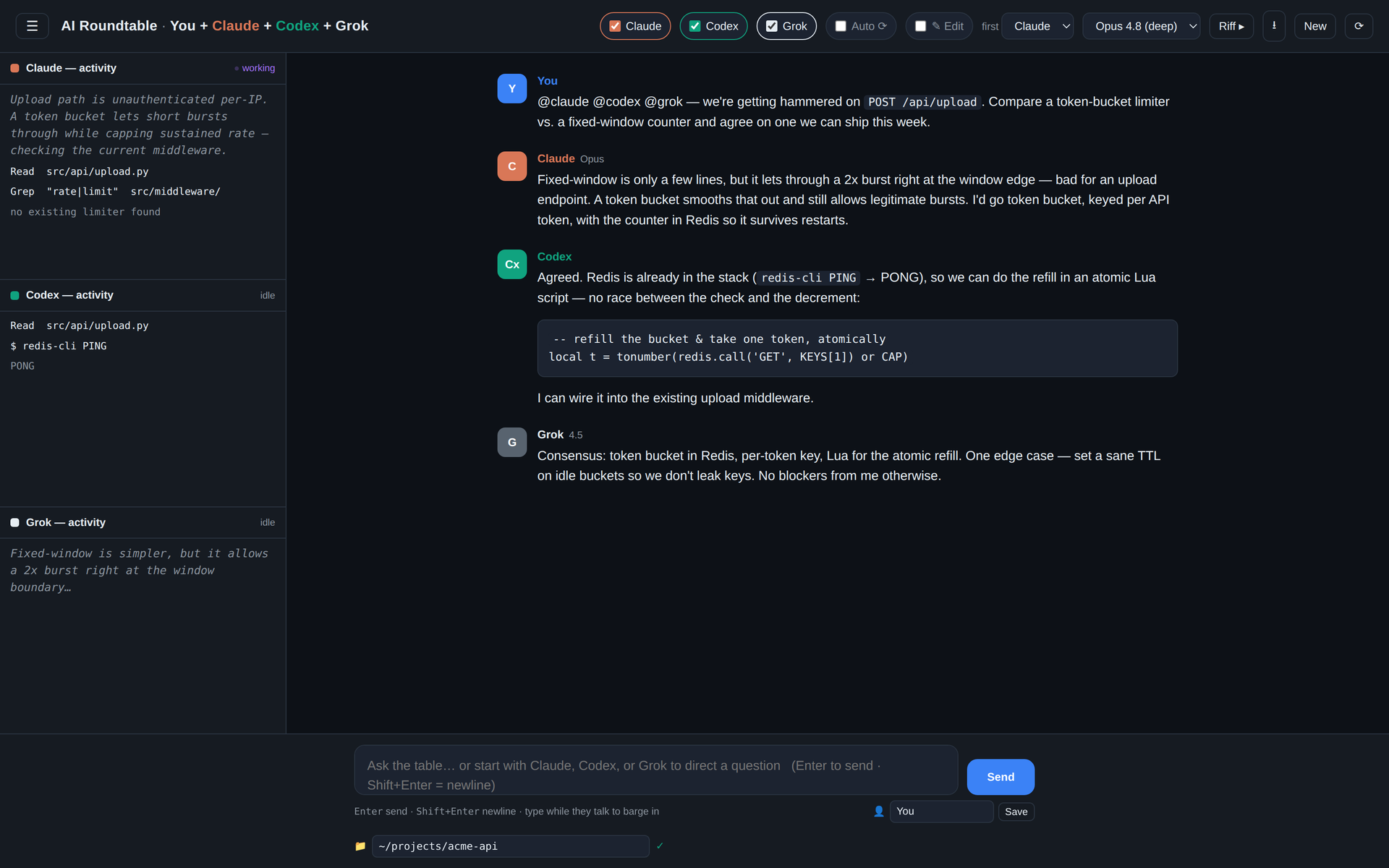
AI Roundtable gives Claude Code, OpenAI Codex, and Grok Build a single transcript — so they answer you and respond to each other, all on your own machine.
Each assistant is handed the complete, labeled conversation before its turn — so the second can build on the first, and the third can weigh in on both.
One conversation owned by the app — no isolated prompts. Everyone sees everything that was said.
Start a message with a name or use @claude @codex @grok to pick who replies. Untargeted assistants stay quiet but keep reading.
Riff runs one round with no new prompt, Auto keeps ordered turns going, and typing mid-response interrupts and takes the floor.
Watch reasoning, file reads, searches, shell commands and results stream in real time as each turn runs.
Every provider gets its own model and effort menu, validated against what that model actually supports.
Saved as JSON locally. Open, rename, pin, delete — and export any transcript to Markdown.
No third-party Python packages, no build step. Install Python, Git, and whichever provider CLIs you want — enable one, any pair, or all three.
Add claude, codex, and/or grok, then sign each in once. The app reuses their existing auth — no API keys.
Grab the repo and start the server. A missing CLI just disables that one participant.
Visit the local address, pick your participants, choose a workspace, and start talking.
# clone and launch
git clone https://github.com/openensemble/AI-Roundtable.git
cd AI-Roundtable
python3 server.py
# then open
http://127.0.0.1:8765/
Windows, macOS & Linux instructions, provider install commands, and configuration options are in the full README.
A 📁 workspace field sets the working directory for every assistant, and edit access is off until you turn it on.
Assistants inspect the workspace but don't change it. Codex and Grok use their read-only sandboxes; Claude runs under read-only permission controls.
Flip Edit on only when you want live changes — files, builds, and Git commands in the chosen folder. Keep important work under version control.
The full shared transcript is sent to whichever provider takes a turn — don't include secrets you wouldn't want that provider to receive.
Free, open, and entirely local. Clone it and start a conversation.